


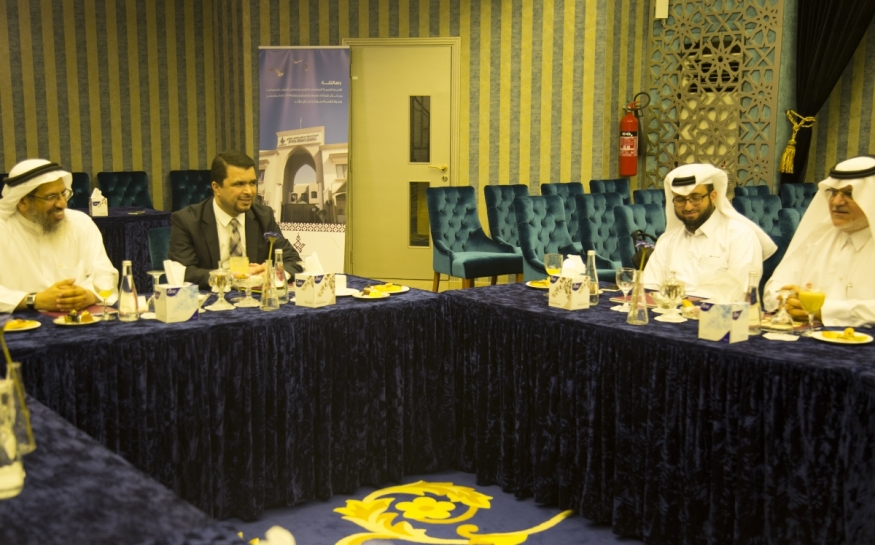
Dr. Al Marwani, Dr. Al Awn, Dr. Maamiche, and Dr. Al Hamad — representatives of the steering committees of both institutions — during the agreement signing meeting.
Within the framework of activating the memorandum of understanding between Abdullah Abdulghani Foundation for Civilizational Communication (“Hadara”) and Qatar University — signed last month — the steering committees of both institutions convened on Tuesday, 28 Rabi’ al-Awwal 1438 AH, corresponding to 27 December 2016, at the Foundation’s headquarters in Al Wakra. The meeting aimed to develop an explanatory memorandum defining the framework of Hadara’s field training project, “Future Leaders,” along with its main tracks. The project is dedicated to providing field training for students of the College of Sharia in several domains. The meeting opened with a welcoming address from Mrs. Buthaina Abdullah Abdulghani, Chairperson of the Board of Hadara, followed by a project presentation delivered by Mrs. Layla Al Ali, General Manager of the Foundation.
The committee from the College of Sharia and Islamic Studies included Dr. Izzeddine Maamiche, Academic Supervisor of the ISESCO Chair and Associate Professor of Contemporary Thought, Religions, and Civilizations at Qatar University; Dr. Hamed Abdelaziz Al Marwani, Assistant Professor in the Department of Da’wah and Media at Qatar University; and Dr. Ahmed Abdullah Al Awn, Assistant Professor in the Department of Fiqh and Usul at the College of Sharia, Qatar University. The Hadara Foundation committee included Mrs. Buthaina Abdullah Abdulghani Al Abdulghani, Chairperson of the Board; Dr. Adel Yousef Al Hamad, Advisor on Women’s Affairs; Dr. Latifa Ali Al Darwish, Advisor on Human Leadership; and Mrs. Layla Al Ali, General Manager.
Both parties reviewed their respective responsibilities within the project. The role of the College of Sharia is to identify the names of participating students, their specializations, and academic years; to define the field training policy and its related requirements; to ensure students’ commitment to the training program; to sign the program documentation; and to notify official bodies of the Foundation’s right to train the students.
The role of Hadara Foundation, in turn, is to provide a safe and dignified educational environment and a stimulating training setting; to issue detailed reports (monthly and final); to conduct field training for students on future leadership and pioneering roles; to equip students with applied leadership and management skills; to develop their thinking skills and train trainers; to establish the optimal approach for field training on women’s issues; and to offer competitive advantages, including accredited certificates, a dedicated women’s training environment, and on-the-job field training.
The session concluded with recommendations and the signing of the project agreement.
Date: Thursday, 30 Rabi’ al-Awwal 1438 AH — 29 December 2016